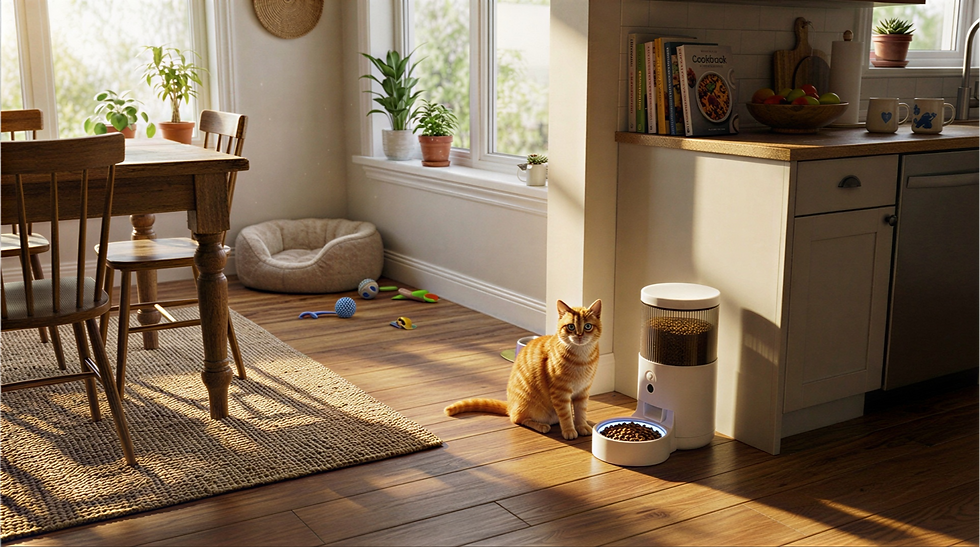
A non-invasive health monitoring system for diabetic cats
GlucoGlo is a research-driven concept exploring how smart, non-invasive monitoring systems could improve long-term care for diabetic cats. The project focuses on reducing stress for animals, lowering cognitive load for owners, and supporting veterinarians with clearer, more consistent health data.
Rather than centering on physical prototyping, the work prioritized user research, market analysis, and system design to identify gaps in existing veterinary care workflows. Insights gathered from owners, clinical practices, and existing monitoring technologies informed the development of a connected product ecosystem combining passive sensing, data visualization, and remote monitoring.
The final outcome presents a speculative yet grounded vision for how emerging technology can shift veterinary care from reactive treatment to preventative, data-informed support, balancing animal comfort, owner confidence, and clinical efficiency.
Conceptual Team Project
Humber College - Industrial Design
Duration: 8 weeks
2025
Contributions:
Ideations + Refinements
Research + Development
Storyboarding + Sketching
CAD + Renders
BACKGROUND
Research & Insight Gathering
Primary interviews, activity mapping, and market benchmarking were conducted to understand the emotional, practical, and technical challenges of managing feline diabetes. Interviews revealed that caring for a diabetic cat is often overwhelming, with owners experiencing stress, uncertainty, and a steep learning curve during diagnosis and treatment. Benchmarking existing glucose-monitoring tools revealed that many current solutions are invasive and uncomfortable for cats, and lack effective tracking, logging, or predictive features. Together, these findings highlighted a clear gap for a more compassionate, user-friendly system that supports both animal comfort and long-term care management.
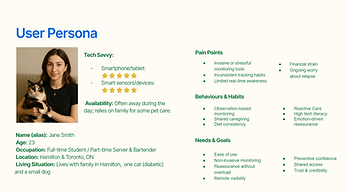
Insights from interviews, activity mapping, and market research were synthesized into a primary user persona to represent common emotional, behavioral, and logistical patterns. AI-assisted analysis was used to cluster recurring themes, identify key pain points, and validate assumptions, helping translate qualitative research into a focused and realistic design target.


Analysis + Diagrams & Mapping
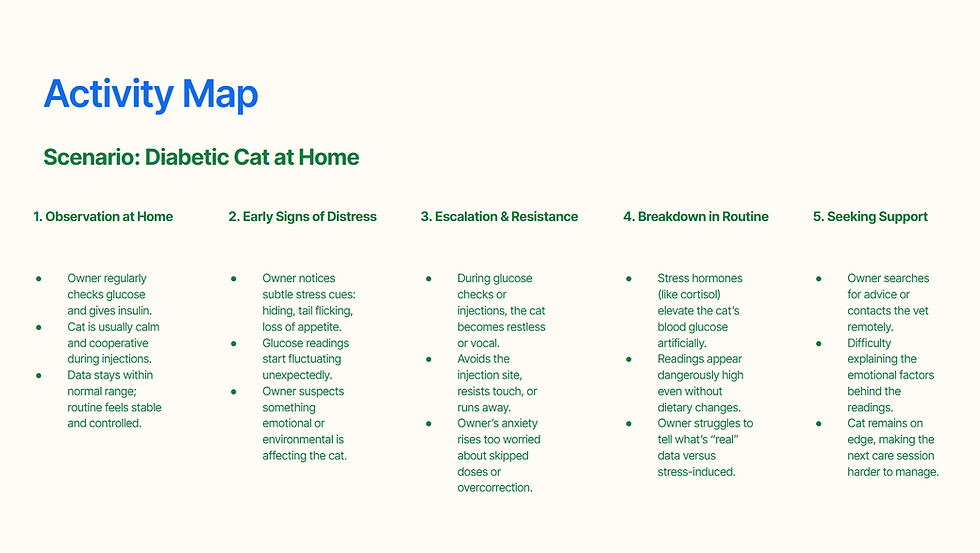
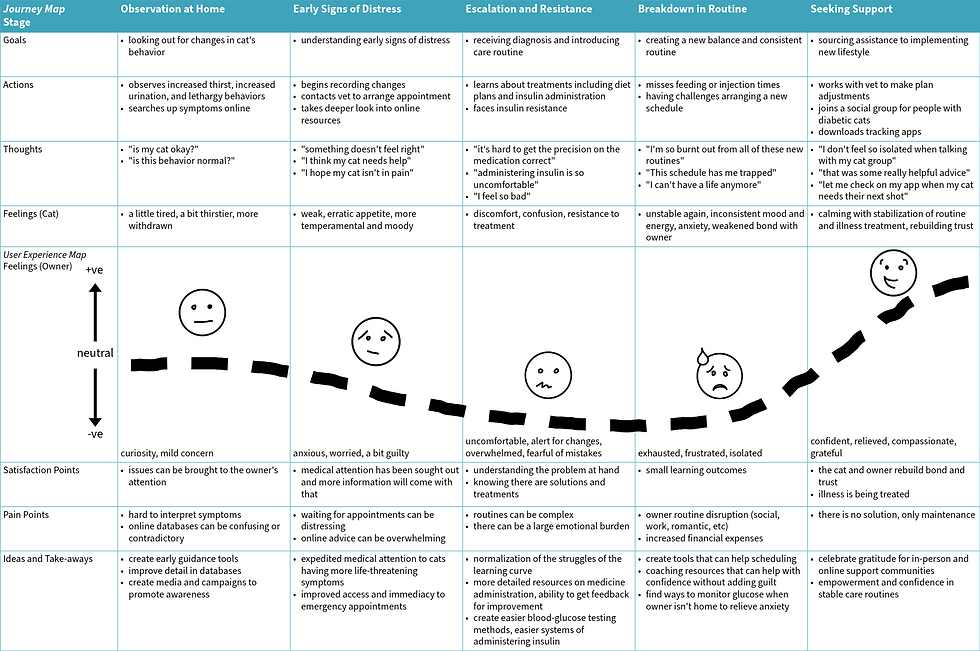
Journey and activity mapping were used to capture both the emotional experience and daily routines involved in managing feline diabetes, highlighting moments of stress, effort, and uncertainty.
Affinity diagramming and a prioritization grid were then used to synthesize research findings, identify recurring pain points, and focus the design on high-impact, feasible opportunities.
MOCKUPS


App Development
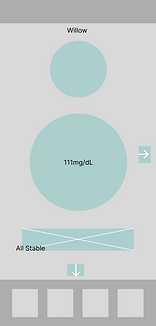
Early low-fidelity wireframes were used to establish layout, hierarchy, and critical information placement, prioritizing clarity and speed of comprehension over visual detail. This stage ensured glucose data, status feedback, and navigation were immediately understandable.
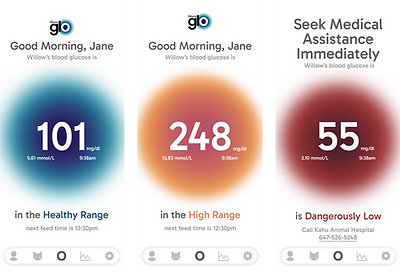
The design was then refined into a high-fidelity home screen that aligns with the final product’s visual language, using color, depth, and typography to communicate glucose status at a glance while creating a calm, reassuring experience for caregivers.
Low-fidelity screens were used to explore data grouping, navigation structure, and how multiple health metrics could be surfaced without overwhelming the user. This phase focused on identifying which information needed to be visible at a glance versus accessible on demand.
The final high-fidelity health overview refines these layouts into a cohesive dashboard, using visual hierarchy, spacing, and progressive disclosure to present trends, summaries, and alerts in a clear and manageable way.
_edited.png)


Ideation + Concept Sketches
Early ideation focused on exploring how health monitoring, feeding, and daily care could be integrated into a single, cohesive system. Rapid sketches were used to test different form factors, component layouts, and interaction points, including food dispensing, camera placement, and non-invasive breath sensing within the bowl. This phase emphasized simplicity, approachability, and seamless integration into the home, allowing the concept to evolve toward a compact, intuitive feeder that supports passive health monitoring without disrupting routine behavior.

Final Prototype
The final app interface refines earlier wireframes into a clear, high-fidelity home screen that communicates glucose status at a glance. Color, scale, and hierarchy are used to instantly convey healthy, high, or critical states, while maintaining a calm and approachable visual language. This ensures caregivers can quickly understand their pet’s condition and respond appropriately without cognitive overload.

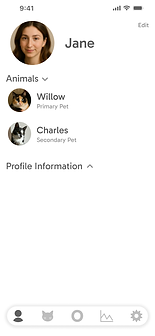
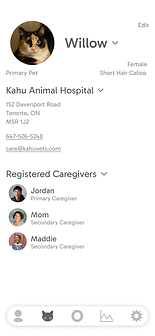
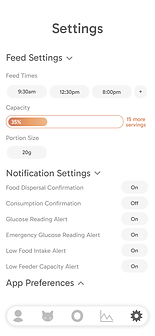
These screens expand the system beyond monitoring into daily care management. Profile and caregiver views centralize pet information, veterinary contacts, and shared access, ensuring all caregivers stay aligned.
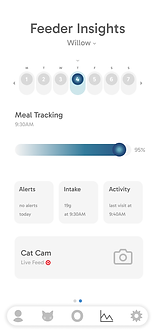
Feeding settings and insights allow owners to control portions, schedules, and alerts while tracking intake patterns over time. Combined with live camera access and summarized health data, the app supports both proactive monitoring and routine management in one cohesive system.



Final Design
The final design integrates feeding, health monitoring, and caregiver feedback into a single, calm, home-friendly product. The feeder combines a non-invasive breath sensor, integrated camera, and controlled food dispensing to support passive glucose tracking during routine meals. Soft geometry, minimal visual noise, and intuitive component placement were prioritized to reduce pet stress while giving caregivers clear, actionable insights through the connected app.
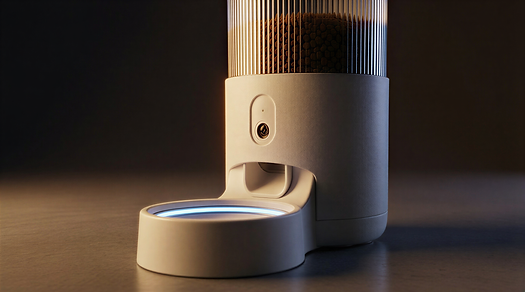


Food Storage Hopper
The top canister holds several days of food and dispenses accurate portions on schedule. Its semi-transparent body makes it easy to see when it needs refilling.

Built-In Camera
A built-in camera tracks the cat’s identity and feeding behavior, giving the owner real-time visibility and helping detect changes early.

Glucose Breath Sensor
A small breath sensor on the rim of the bowl reads the cat’s glucose levels while it eats. No needles, no stress, just passive monitoring every meal.