

Exploring minimal geometry, sustainable construction, and a bold brutalist identity.
Modern apartment living often demands furniture that is lightweight, space-efficient, and visually adaptable. STAX was developed as a response to these constraints, a chair that maintains a strong sculptural presence while remaining practical, durable, and easy to store.
The design explores how simple geometric shifts in the frame and seat profile can create a recognizable character without relying on unnecessary complexity. Early iterations tested proportions, stackability, user comfort, and material transitions to ensure the chair feels expressive while still being effortless to manufacture.
STAX aims to balance functionality and form: a clean silhouette, a sturdy metal frame, and a layered seat detail that gives the chair identity without compromising usability or sustainability.
Team Project: Max Labutte & Philip Moriana
1st Place Award - Humber 2025 Chair Show
Humber College - Industrial Design
Duration: 12 weeks
2025
Contributions:
Ideation + Refinement
Sketches
Modelmaking
CAD
Rendering
In collaboration with:


Background
As interior spaces become smaller and more dynamic, furniture needs to stay light, compact, and easy to store. Instead of following the common lounge-chair route taken by many teams, I explored a side-chair typology to focus on a tighter footprint and stronger stackability. This approach set the foundation for a clean, functional form that fits a wide range of environments.
Challenges & Constraints
Sustainable Material

Plastics Flux

Steel Tubing
Material choices also limited finishes and hardware options, prioritizing durability, recyclability, and long-term use over decorative treatments.
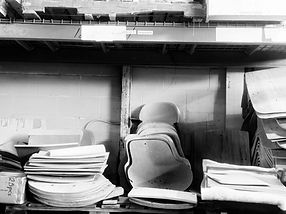
Plastics Flux was interested in the project, so they provided us with the opportunity to utilize their material in our chairs as a key visual.
Steel tubing was the key material to be used. This gave us a chance to experiment with unique tube and beam forms.


While many existing side chairs are well-designed and visually refined, they often prioritize form or comfort over space efficiency. Their bulky footprints and limited stackability make them less suitable for compact, flexible interiors, underscoring the need for a chair designed specifically with efficient storage and adaptability in mind.
Design Opportunity
The research showed a clear gap between durable, stackable side chairs and those designed for modern, compact interiors. With steel tubing, Plastics/Flux, and sustainable goals, there is an opportunity to create a chair that is minimal, efficient, and visually strong without sacrificing usability.
Design of a compact, stackable, and sustainable side chair that balances simplicity, durability, and modern identity.


The Creative process was focused on the metal tubbing frames and how we could differentiate and or rather create unique solutions to allow an aesthetic art piece and functionality in terms of stackability.
Process


Final Design

The final design is a compact, stackable side chair built from steel tubing and Plastics/Flux components, balancing durability with a minimal, modern identity. Its geometric frame provides structural efficiency while the layered seat detail adds subtle character. STAX is designed to be sustainable, easy to manufacture, and adaptable to a wide range of small interior spaces.


Stackable Steel Frame
The chair’s unique steel-tubing frame is designed to enable efficient, smooth stacking without adding visual or structural bulk. The angled legs and continuous tube geometry align precisely when nested, allowing multiple chairs to stack securely while maintaining a minimal footprint. This construction not only reduces the space needed in compact interiors, but also strengthens the frame through its natural triangulation. By relying on bent steel tubing rather than complex joints, the design remains durable, lightweight, and easy to manufacture, offering a simple yet highly functional stacking solution suited for everyday environments.
Interchangeable Components
The chair’s backplates and upholstered seat are fully interchangeable, allowing users or manufacturers to easily update materials, colors, or textures. Each component is secured using a simple four-bolt system, making removal and replacement as straightforward as assembling basic IKEA furniture. This approach not only extends the product’s lifespan by enabling repairs and customization, but also supports sustainable manufacturing by allowing individual parts to be upgraded without replacing the entire chair.


Sustainable Material System
Every component of the chair is designed with sustainability at its core. The backplates are produced using Plastic Flux’s recycled composite material, giving each chair a unique aesthetic while diverting waste from landfills. Both the metal frame and plastic components are 100% recyclable, allowing the entire product to be disassembled and reprocessed at the end of its life. By prioritizing mono-material construction where possible and reducing the need for adhesives or complex joints, the design supports a circular manufacturing model in which parts can be reclaimed, reused, or remade without generating additional waste.


